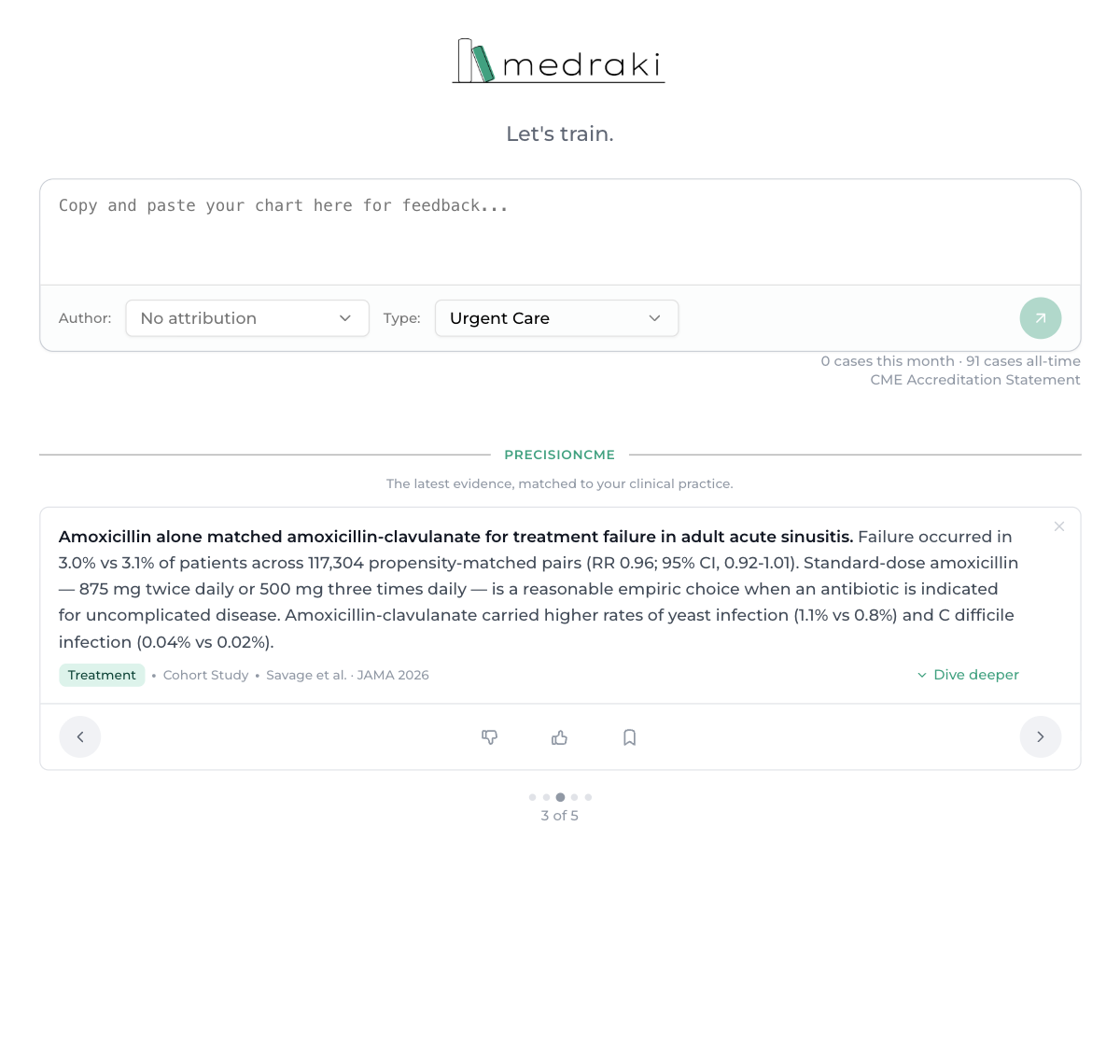
Copy and paste a chart into Medraki's HIPAA-compliant platform. Discover summaries of recent literature matched to your cases through PrecisionCME™.
For medical directors and practice owners
Build clinical competence.
Make progress visible.
Medraki connects chart review, personalized learning, and mentorship in one guided system.
HIPAA Compliant
Standardizing high quality care at


How Medraki Works
One connected system.
Identify opportunities to improve care and strengthen documentation with immediate feedback on your chart. Flag interesting or challenging cases for your mentor to review.
Keep chart submissions, mentor reviews, and clinician acknowledgments in one place. See what's been reviewed and acknowledged, with a dated record of each step.
Explore the clinical topics you've encountered through your knowledge map. Identify gaps in exposure and use them to guide learning and mentoring conversations.
Building a fellowship or onboarding program?
See how we can help. →Sample Clinician Modules
Build mental models for clinical practice.
HEENT
Ear Foreign Body
What Is It? Should I Try? When Do I Stop?
Full module with knowledge check
Explore this module (opens in a new tab)Our Story
Did you know Japanese rugby players bow before stepping on and off the pitch? I was surprised to observe this recently. We do the same before stepping on and off the mats in jiu-jitsu, an art I've been practicing even before I started my medical training. It's a sign of respect to our training partners, a gesture of humility for the opportunity to learn, and a mental reminder to leave the day's problems behind.
The next morning, as I stepped through the emergency department's sliding doors, I experimented with bowing - mentally, at least (I didn't want any strange looks!). Perhaps an overly romantic view of modern medicine, but I've grown to appreciate medicine as a craft - one that has shaped my identity and purpose - and the ED and urgent care clinic will always be spaces where I continue to grow.
Medraki comes from medicine and meraki: the soul, creativity, and individual essence we put into our work. Much of my own learning happens after a shift, when I look up one or two details about a patient I've just cared for. Medraki connects that everyday learning with mentorship and a clear record of growth.
I've served as a medical director for almost a decade. When I was first asked, I was one year out of residency and certain I had nothing to contribute. I quickly learned how much of the work happens after everyone else unclips their badges: patient complaints, unexpected outcomes, difficult conversations, schedule callouts. “I did it for the riches and glory!” said no medical director ever.
But there's a part of the role that makes that work worthwhile. One of my mentors offered a simple test of a good medical practice: when a family member needs care at your clinic or ED, do you need to call ahead to check who's on? Or can you perform a trust fall into the team you trained and built?
That kind of trust takes deliberate work: developing clinical judgment, providing meaningful feedback, and helping each clinician grow. Medraki is built to support that work.
Medraki is owned and operated by practicing clinicians. I use it every shift. There are no institutional investors or pharmaceutical sponsors. We're clinicians partnered with engineers who understand healthcare, building something we need ourselves.
I invite you to join us.
Let's train,


“During a busy shift, detailed feedback on completed notes is hard to come by. Medraki fills that gap. The AI review is thorough and makes sure I hit every detail. And the Case Portfolio is something I can use to track my own progress or showcase to future employers: a documented record of my best cases and procedures.”
Kayla W, PA-C
Urgent Care Clinician, Ocean, New Jersey
“Clinical feedback from my supervising physician is rare. Medraki shows me what I missed - the questions I should have asked, the history I didn't dig into. But it also pushes me to think forward: what if this patient develops something else? It's sharpening my clinical decision making in ways I didn't expect.”
Aimee N, FNP-C
Urgent Care Clinician, Los Angeles, California
“I didn't have structured clinical feedback before Medraki. Now I upload my patient visits regularly to evaluate my strengths and weaknesses - and it's already changing how I practice. There's also something freeing about getting feedback this way: I don't worry about being judged for not knowing something or coming up with the wrong plan. I wish I'd had this during PA school.”
Heather R, PA-C
Urgent Care Clinician, Seattle, Washington
“I wasn't explicitly documenting the negative findings that supported my decision-making. In low-risk chest pain cases, for example, I'd note a normal assessment but never clearly state the absence of exertional symptoms, radiation, or risk factors. Medraki caught that. The feedback is more comprehensive than what I get verbally from preceptors. People fall into procedural habits, take shortcuts, or lean on the EMR without thinking through all the differentials. AI presents everything faster and more thoroughly. Charting is an art, and I'm not a master. This has made clear how much more I have to learn and given me a way to actually work on it.”
Khristine H, FNP-C
Urgent Care Clinician, San Jose, California
“I often feel AI feedback is more thorough and really paints the picture, elaborating more than clinical preceptors, who often don't have time to discuss with me, or I with them, because the day is busy.”
Michelle C, PA-C
Urgent Care Clinician, Berkeley, California
“It helps avoid tunnel vision - highlighting something you hadn't considered or clarifying why a diagnosis isn't as high on your radar. Some of it has genuinely changed how I practice, small things that stick, like always getting a visual acuity for eye complaints or knowing when not to include HSV in STI testing. And having those real cases documented is something I can actually pull from for interviews and career progression.”
Taylor A, DNP, FNP-C
Urgent Care Clinician, Corte Madera, California
“It removes the sense of judgment, so I can focus on the feedback itself. I can track patterns over time, see how my reasoning has improved, and have concrete evidence of my clinical growth for career progression.”
Logan H, PA-C
Urgent Care Clinician, Los Angeles, California
“Medraki provides real-time feedback for my charts and helps guide my decision making with difficult cases.”
Naomi C, FNP-C
Urgent Care Clinician, San Francisco, California
“I LOVE IT. One of my weakest areas is documentation, especially MDM. The AI really highlights what's missing from my notes - differentials, red flags on the exam. The feedback is genuinely helpful.”
Grace L, PA-C
Urgent Care Clinician, Seattle, Washington
“I've seen tremendous growth in my charting and clinical decision-making.”
Michelle S, FNP-C
Urgent Care Clinician, Paso Robles, California
1 of 10
Pricing
$199per clinician per year
Billed annually
- Unlimited AI chart reviews
- Mentor review and feedback
- AMA PRA Category 1 Credits™ through eligible learning and chart-review activities
- Clinical learning modules and knowledge checks
- Personalized literature summaries with PrecisionCME™
- Documented mentor reviews and clinician acknowledgments
FAQs
A few more
details.
Medraki is a HIPAA-compliant platform with data encrypted in transit and at rest. Visit our Trust Center to learn more about our security practices.